
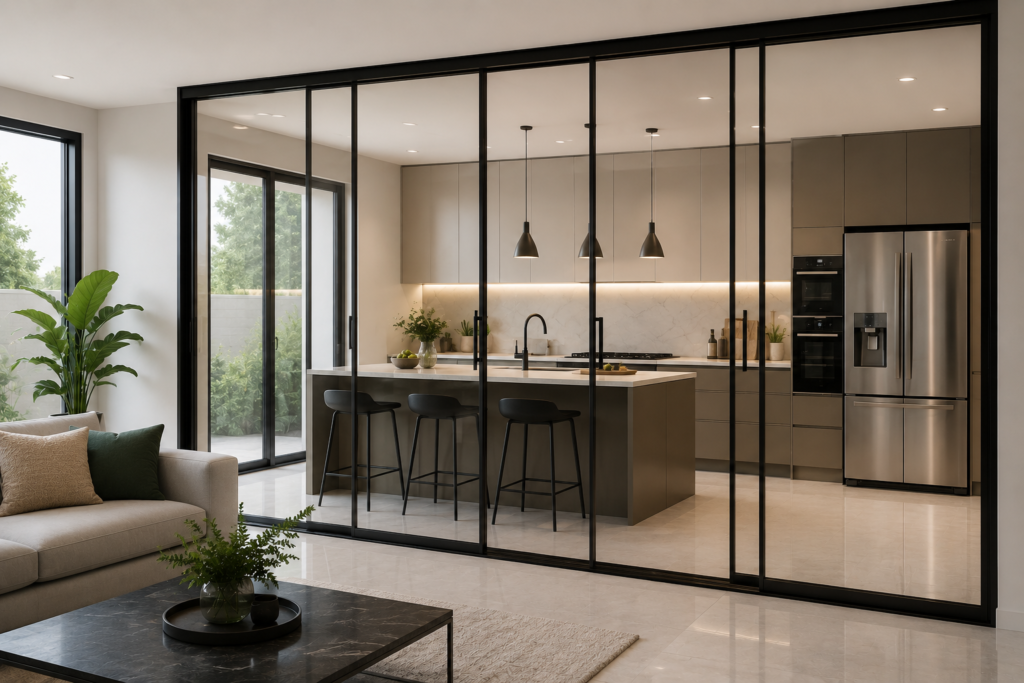
Open kitchens look great. They make a home feel larger, bring more light into the living area and make it easier to stay connected with family or guests while cooking.
But after living with one for a while, many homeowners discover the downside.
Cooking smells travel into the living room. Noise from appliances becomes difficult to ignore. Air conditioning has to work across a larger space. And sometimes, you simply don’t want the kitchen on display.
The obvious solution is to close the kitchen.
The problem? Building a solid wall can take away exactly what made the open kitchen attractive in the first place.
This is where a glass kitchen partition can work particularly well.
Why Completely Closing the Kitchen Isn’t Always the Best Answer
If your kitchen was designed as part of an open-plan living and dining area, adding a solid partition can change the character of the entire room.
Natural light may be reduced. The kitchen can suddenly feel smaller. The living room may also lose some of its sense of space.
Glass gives you another option.
You can create a physical separation between the kitchen and living area without creating the visual weight of a traditional wall.
When the glass is clear, you can still see through the kitchen and the room continues to feel connected.
You get separation without making the home feel closed.
Sliding Glass Partitions Work Particularly Well
For many homes, a sliding glass partition is one of the most practical ways to separate an open kitchen.
The reason is simple: you can decide when you want the kitchen open and when you want it closed.
Preparing something simple? Keep it open.
Cooking something with strong aromas? Close the partition.
Having guests over and don’t want kitchen noise travelling into the living room? Close it.
Once you’re finished, open the panels again and you have much of the open-plan feeling back.
Sliding systems are also useful when there isn’t enough space for a conventional hinged door to swing comfortably.
Our Recommendation
If your main concern is cooking smells but you still want the kitchen and living area to feel connected, a clear sliding glass partition is usually a good place to start.
For homeowners who also want some privacy, frosted, fluted or tinted glass can be considered depending on the interior.
The number of panels and how they open should be decided after measuring the space—not simply from a reference photo. A beautiful partition still needs to be practical when you’re using the kitchen every day.
Frameless or Framed?
This is usually one of the first design decisions.
A frameless glass partition has a very clean appearance. With fewer visible profiles, the glass almost disappears into the room. It works particularly well with minimal, contemporary interiors.
A framed glass partition makes more of a design statement.
Slim aluminium frames can complement darker kitchens, industrial-style interiors or homes where black or metallic details are already being used.
Neither is automatically better.
The right choice depends on the kitchen, the size of the opening and the overall interior design.
We normally recommend looking at the entire room rather than choosing a partition from a catalogue image. A design that looks beautiful in one property may not suit another.
What About Cooking Smells?
This is one of the main reasons homeowners consider closing an open kitchen.
A properly designed glass partition creates a physical barrier between the kitchen and adjoining space, which can help limit the movement of cooking smells compared with leaving the kitchen completely open.
However, the partition shouldn’t be treated as a replacement for good kitchen ventilation.
Your cooker hood and extraction system still have an important job to do.
Think of the glass partition as part of the solution rather than the entire solution.
Clear Glass Isn’t Your Only Option
Most homeowners immediately picture completely transparent glass, but there are other possibilities.
Clear glass is ideal when maintaining the open appearance is the priority.
Frosted or partially frosted glass can provide more privacy if you don’t always want the kitchen fully visible.
Tinted glass can create a stronger architectural look and may work particularly well with darker cabinetry or aluminium frames.
The important thing is not to choose the glass independently from the kitchen.
Cabinet colours, flooring, lighting, handles and other finishes should all be considered.
Don’t Forget About the Track and Opening
People naturally focus on the glass, but the way the partition opens is just as important.
Before deciding on a sliding system, look at where the panels will sit when they’re open.
Will they stack to one side?
Will the opening still be wide enough?
Is there cabinetry, furniture or a wall that restricts movement?
Where will the track be installed?
These details can make the difference between a partition that looks good in photographs and one that is genuinely convenient to use every day.
This is why accurate site measurements are important before finalising the design.
What If Your Kitchen Opening Is Very Wide?
A wide opening doesn’t necessarily mean you have to give up on the idea.
Instead of using one large panel, the opening can often be divided into multiple glass panels.
Depending on the layout, some panels may remain fixed while others slide.
This can create a much cleaner installation and make the moving panels easier to operate.
For larger openings, the proportions of the frames and panels become particularly important. Too many divisions can make the partition look busy, while very large panels may not always be the most practical solution.
The design needs to find the right balance.
Is a Glass Kitchen Partition Difficult to Maintain?
Generally, no.
Like any glass surface, fingerprints and cooking residue will become visible over time, particularly on clear glass close to the cooking area.
Regular cleaning with an appropriate glass cleaner is usually enough to maintain the appearance.
Tracks and moving components should also be kept clean so that sliding panels continue to operate smoothly.
If easy maintenance is important to you, mention it when discussing the design. The configuration and hardware can make a difference to everyday cleaning.
When Would We Recommend a Glass Kitchen Partition?
A glass partition is worth considering if you like your open kitchen but want more control over how it connects with the rest of your home.
It makes particular sense when:
- Cooking smells frequently reach your living or dining area.
- You want to reduce kitchen noise without building a solid wall.
- Natural light is important.
- You occasionally want to hide the kitchen from the living area.
- You want to retain a modern, open interior.
- A traditional hinged door would take up too much space.
On the other hand, if your priority is complete visual privacy or maximum acoustic separation, a different solution may be more appropriate.
That’s why the starting point should always be how you actually use the space.
Before You Choose a Design, Look at the Space
It’s easy to save a photograph from Pinterest or Instagram and say, “I want exactly this.”
But glass partitions aren’t one-size-fits-all.
Ceiling height, opening width, flooring, kitchen cabinetry, existing walls and even where furniture sits can affect the final design.
A good partition should look as though it belongs in the home rather than something that was added afterwards.
That’s what we look for when designing kitchen glass partitions at Crystal Vista.
We consider the opening, how you want to use the kitchen and the style of the surrounding interior before recommending the glass, frame and opening configuration.
Thinking About Closing Your Open Kitchen?
You don’t necessarily have to choose between an open kitchen and a completely closed one.
A well-designed glass partition can give you some of the advantages of both.
Keep it open when you want the space to feel connected. Close it when you’re cooking or need separation.
If you’re considering a kitchen glass partition in Dubai, Crystal Vista can assess your space, take measurements and recommend a configuration that works with your existing kitchen.
The goal isn’t simply to install a piece of glass.
It’s to make the kitchen work better without losing what you liked about the open-plan design in the first place.